Numerical Analysis and Simulation Services
Applications
Mechanical-Structural Field
Our FEM simulation service is ideal for:

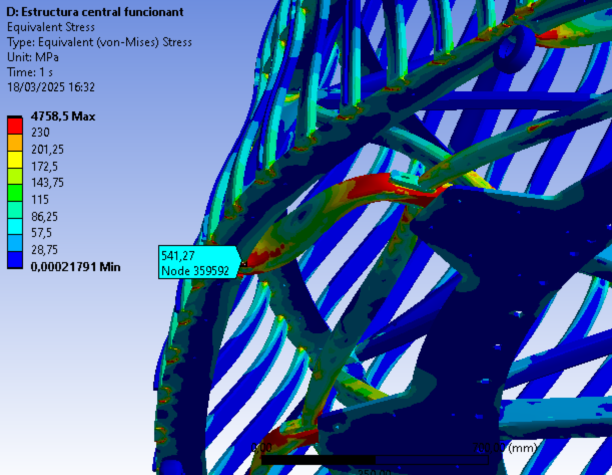
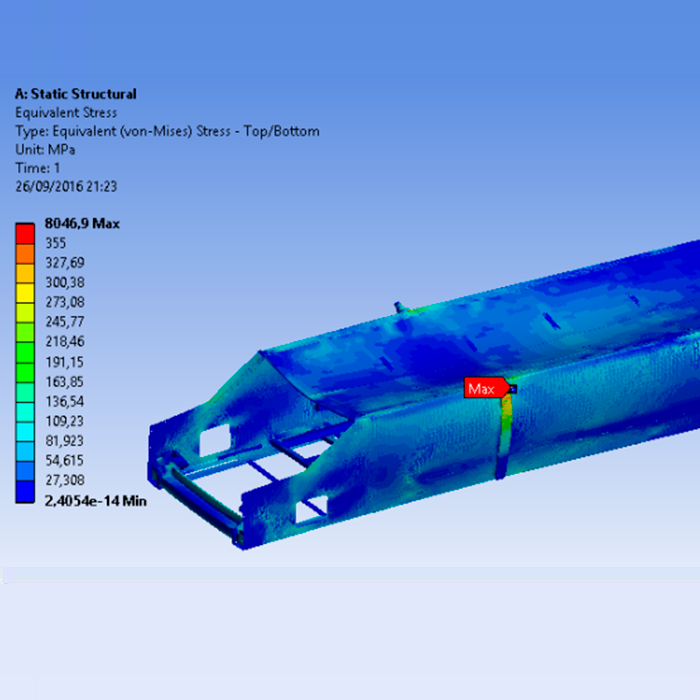
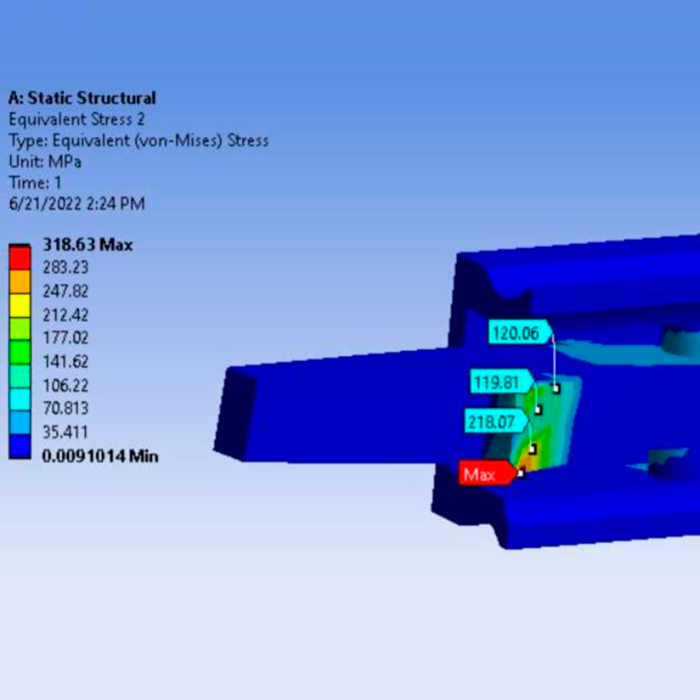
Stress and Strain Assessment
Identify critical areas and ensure the strength of your components.

Fatigue and Component Life Analysis
Anticipate failures and extend the service life of your products.

Thickness and Geometry Optimization
Improve performance and reduce material usage without compromising safety.

Validation Against Standards And Technical Requirements
Ensure your designs meet international standards and client specifications.
01.
Linear Static Analysis
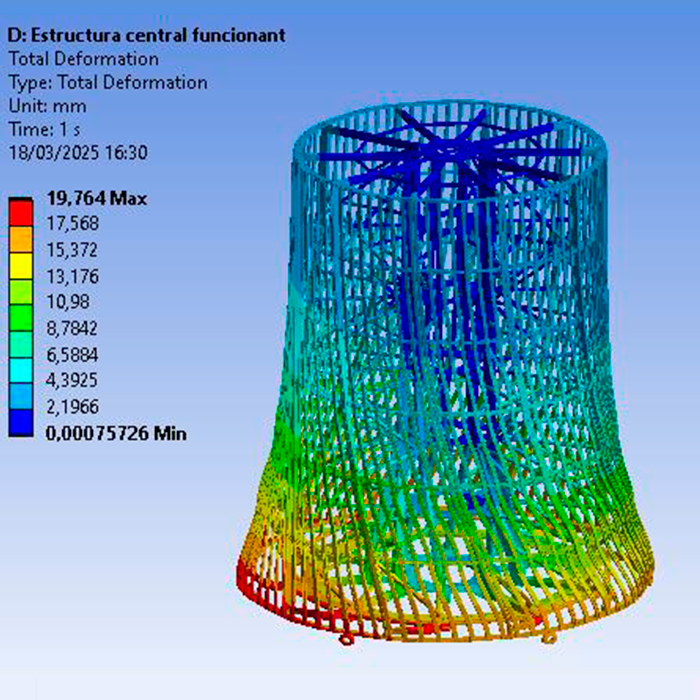
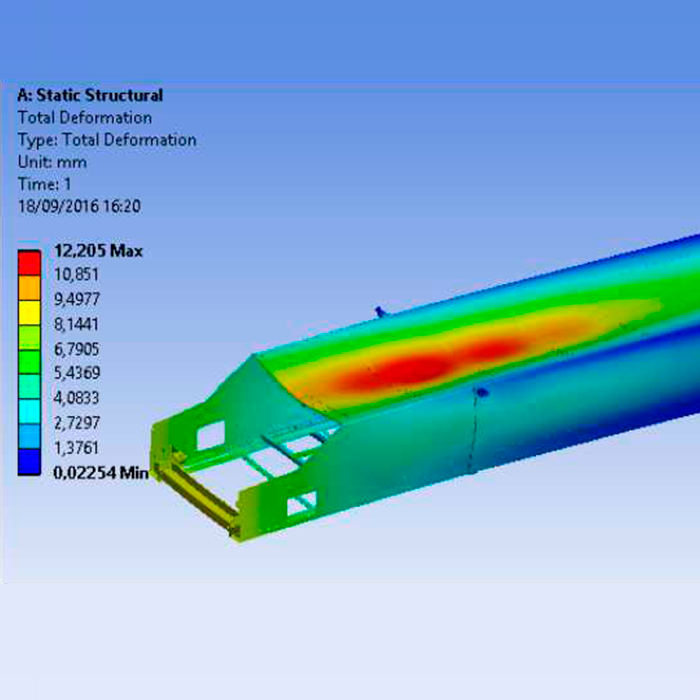
- Displacements of the component or structure.
- Mechanical stresses and strains.
The results are compared with the material’s yield properties, validating that the design operates within the elastic range and ensuring its structural integrity.
02.
Nonlinear Static Analysis
- Large deformations.
- Nonlinear material behavior.
- Contacts between parts or assemblies.
This type of analysis provides more realistic results for displacements, stresses, and mechanical strains in components or structures subjected to demanding conditions.
03.
Buckling Analysis
Buckling analysis is performed on slender components or structures subjected to compressive loads.
- Determination of the buckling factor.
- Evaluation of structural stability.
This analysis makes it possible to determine whether the model may experience buckling under the applied load conditions.
04.
Dynamic Analysis
Dynamic analyses allow the study of the behavior of components and structures subjected to time-varying loads. There are three main types:
Modal Analysis
The natural vibration frequencies of the component or structure are extracted.
These frequencies are compared with the excitation frequencies to avoid resonance phenomena, which are undesirable in mechanical design.
Harmonic Analysis
The component or structure is subjected to a sinusoidal load at different frequencies.
Displacements, stresses, and strains are obtained as a function of frequency, evaluating their compatibility with real excitations and avoiding resonance ranges.
Spectral Analysis
In this case, loads are applied as displacements, velocities, or accelerations depending on frequency at the support points.
It is particularly useful for studying random vibrations or seismic actions (earthquakes).
05.
Fatigue Analysis
In fatigue calculations, the component is subjected to time-varying loads (time series).
Mechanical damage is evaluated using S/N or E/N curves, for both high-cycle and low-cycle fatigue.
The calculated damage indicates the probability of crack initiation and allows estimating the component’s service life under fatigue.
06.
Bolted Joints
The behavior of bolts in a joint subjected to static or fatigue loads is evaluated.
- Calculation of the safety factor.
- Validation of the selected bolt.
- Recommendations for modifications or improvements during the design phase, if necessary.
07.
Welded Joints
The stress experienced by a welded joint under static or fatigue loads is analyzed.
- Calculation of the safety factor.
- Validation of the joint’s capacity to withstand the applied loads.
08.
Thermal Calculations (Non-CFD)
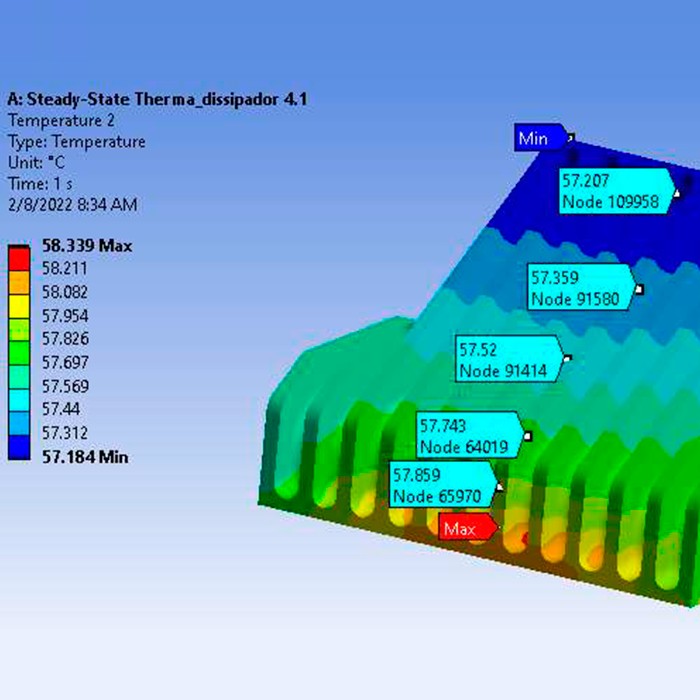
The behavior of the component under known thermal loads is simulated, evaluating the temperature distribution.
- Thermal deformations.
- Thermo-mechanical stresses induced by temperature.
Get in Touch with Us
Contact Information
- Avinguda Doctor Farrero, 14, 4º 2ª
08310, Argentona, Barcelona - +34 660 063 721
- info@cetermconsulting.com